

- Relationships
- My Partner
- Spiritual Love Making
- Positive Relationship Attitudes
- Love one another, or die…
- Walls and Distancing
Most people desire an intimate friendship in their life.
For many this is connected with a single person and a commitment of sexual intimacy, often in marriage. The expectations on such a relationship are enormous, influenced by movies and stories where we seek a partner with whom we will live ‘happily ever after’.
The process of selection of such a person as a partner can vary from ‘arranged marriage’ where family and society take a significant role in choosing the person, to ‘falling in love’ where the boundaries of self are temporarily lost in absorption of the object of each other’s love.
In all cases, the prime decisions are not made by the conscious mind, but by the Xconscious. This is important to acknowledge, as it helps with understanding what happens as time passes and the couple grows or wanes in affection, friendship, expectation and acceptance etc.
What do you look for in a partner? Are you sure? Have you sorted out your not-negotiables, such things as future family, income, home chores and even what happens at death? Even if you have been in a relationship for a long time, it may be useful to run through the IQS on your partner (below).
What about romance, and finding a soul-mate?
James Hollis suggests that both the value and process of soulful romance rest in what he calls radical conversation, in which one intends, continuously, to discover more and ever more about oneself and the other Through such an exchange between two mysteries, one draws nearer to the central mystery of life. Hollis lists three components to such a soul-to-soul encounter.
- The partners must assume responsibility for their own psychological wellbeing.
- They must commit to sharing the world of their own experience without reproaching the Other for past wounds or future expectations. Similarly, they are to endeavor to hear, without feeling defensive, the experience of the Other.
- They must commit to sustaining such a dialogue over time. . . . Only radical conversation, the full sharing of what it is like to be me while hearing what it is really like to be you, can fulfill the promise of an intimate relationship. One can only engage in radical conversation if one has taken responsibility for oneself, has some self-awareness, and has the tensile strength to withstand a genuine encounter with the truly Other.
A list of common qualities sought in a partner:
1. Emotional Maturity
Every person comes equipped with flaws and emotional baggage. Seeking perfection is an idle search. Instead, what you should look for in a partner is emotional maturity. This means someone who is willing to think and learn about themselves, who is open to reflecting on the past and evolving in the present. This certain someone should be non-reactive, in the sense that they think before they act. They don’t let their instant emotions rule their actions. They are independent and self-assured, which means they aren’t looking to you to fix or complete them.
2. Openness
Along with emotional maturity, one of the things to look for in a partner is an openness to feedback. Not only should your partner be interested in changing his or her own self-limiting behaviors, but he or she should be open to hearing what you have to say. Open and honest communication is vital to sustaining a close relationship. When a person puts up a wall that says, “I am unwilling to listen and unwilling to change,” there is really little room for growth on both your parts. When a couple is willing to openly communicate about themselves and their feelings and reactions to each other, they avoid building a case and creating tensions that later tear them apart. By being resilient and hearing each other out, they construct a solid foundation for a workable relationship that is sure to evolve over time.
3. Honesty
While deception is generally frowned upon, lying is sadly common in many relationships. Some couples believe they need lies to survive, yet research shows that lying less is linked to better relationships. Being able to trust is so important when choosing a life partner. Look for someone whose actions meet their words and someone who is open about how they feel. It’s better to be with someone who will tell you what’s on their mind, even revealing that they’re attracted to someone else, than to make those topics taboo or off limits, which can create an air of secrecy. Even when the truth is hard to take, it’s in your best interest to really know your partner. Someone who hides aspects of themselves can leave you feeling insecure and mistrusting.
4. Respectful and Sensitive
One of the most valuable qualities to look for in a partner is respect. When you find someone who encourages you to be yourself, you can feel secure in your relationship, yet independent within yourself. It’s easy to feel loved when someone encourages you to do what lights you up and makes you happy. This same person may be willing to challenge you when you’re engaging in self-destructive attitudes and behaviors. This attuned way of relating is both sensitive and respectful of who you are as an individual, separate from your partner. When someone appreciates you and takes an interest in the things you are passionate about, you can really share life with this person, while continuing to pursue your unique interests.
5. Independent
People often make the mistake of thinking that a relationship is a way for two people to become one. Attempting to merge your identity with someone else is not only bad for you, but bad for the relationship. When couples fall into routine and forego their independent attraction to each other, things tend to go south. Real relating is replaced with an illusion of connection or “fantasy bond.” This sense of fusion subdues the passion in a relationship. By maintaining your individuality: enjoying separate interests along with interests you share with your partner, keeping your outside friendships and always trying new things, you keep romance and attraction alive.
6. Empathetic
In addition to being a good communicator, you should look for a partner who is empathetic. It’s fortunate to find someone who is willing to hear out and relate to your struggles. When you have a partner who aims to understand and feel for what you experience, you are able to be more vulnerable and reveal more aspects of yourself. Compassion is one of the most important human traits, and you should strive to find a partner who can easily feel for other people.
7. Physically Affectionate
One of the symptoms of a “fantasy bond” involves a lack of affection and sexuality between a couple. Physical affection is an important part of life. It is a way people stay connected and close to those they love. Keeping your relationship vital and intimate is part of making love last. It’s important to choose a partner who accepts love and affection, who is also giving of love, affection and acknowledgment. Your sexuality is a part of you that shouldn’t fade with time. Keeping your feelings alive means expressing them verbally and physically.
8. Funny
Sense of humor is as important as it’s made out to be. Laughter is the best medicine when it comes to most things, but especially relationships. Someone who is happy to just hang out, have fun and laugh with you is someone worth sticking with. Being easy-going and willing to laugh at yourself are highly beneficial characteristics to look for in a partner. A person who is lighthearted can be well worth getting serious with.
When we consider the many things to look for in a partner, each of us will have a different idea of what’s important. We may be drawn to more specific traits like creativity or work ethic, green thumbs or blue eyes. Yet, choosing people who strive to live by the qualities listed above will help ensure our best chance at happiness in our relationship.





 congregation. However the death of both her mother and her daughter led her to look for a different level of connection to what she gained from her weekend religious activities. Through LISN membership Annabel found inspiration from others who have had similar losses, and who were nearby.
 Ethelia is lonely, new to her new village, and with specific spiritual interests which could be called ‘mystic’. Her country does not permit views contrary to the national religion. Ethelia longs for people to explore questions and inspiration with, and finds LISN.
 anyone else knowing what they are. He likes that.
 He joined LISN and then discovered he can also upload his entire cohort of parishioners as users, so that they are part of the membership of LISN, but specifically assigned to his care group.
 He had recently found a number of small groups existed that he did not know about. His attempts to get people to let him know had not worked, probably because things were constantly changing and there was no online method for people to update their own connections.
 She looked online and found lots of offerings but no indication if they would match what she was looking for. By registering and defining membership with LISN she was able to define her own spiritual expectations in a fun way, and in doing so the list of local Spiritual Directors was somehow narrowed down to those who matched her needs and style. She loved not having to research a whole lot of options and found it easy to choose one that works well with her spirit.
 becomes:


 LISN also has mapping and organizational support for small groups, circles, councils. LISN can link a person to spiritual circles or groups who are local or in a vicinity of interest.


 The content of LISN is kept in pages of information, which are categorized according to content. You can find such pages filtered by category, by selecting the LISN category from the side bar drop-down list. You can find Interactive Question Surveys (IQS) is a category.
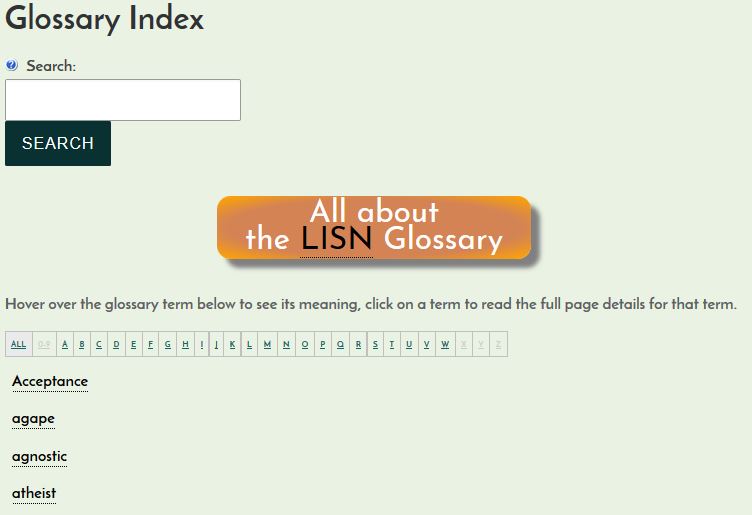
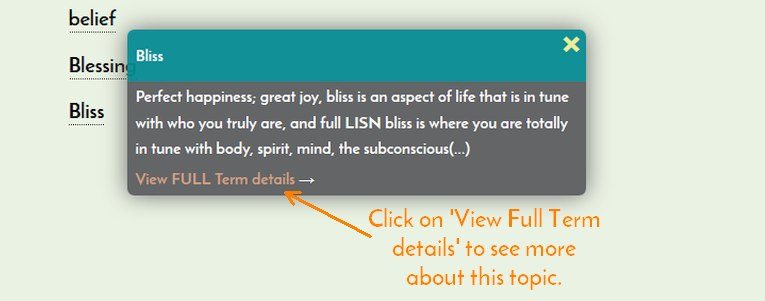
 Click here to go to the glossary and learn more.
 Click this arrow button to submit your feedback!
 or enter your search address for where you are.