
The spiritual journey continued with the Hindu sages in India, who wrote the Upanishads about 800 BCE but whose documented history goes back a lot further with Vedic Brahmanism. The word “Upanishad” has been interpreted by Shankara to mean “that which destroys all ignorance and leads us to Brahman.” Brahman meaning the “Cosmic/creative principle or energy that is the unity of all that exists” (the source of the Big Bang)
Mysticism means a spiritual grasp of the aims and problems of life in a much more real and ultimate manner than is possible to mere reason.
A developing life of mysticism means a gradual ascent in
the scale of spiritual values, experience, and spiritual ideals. As such, it is manysided in its development, and as rich and complete as life itself.
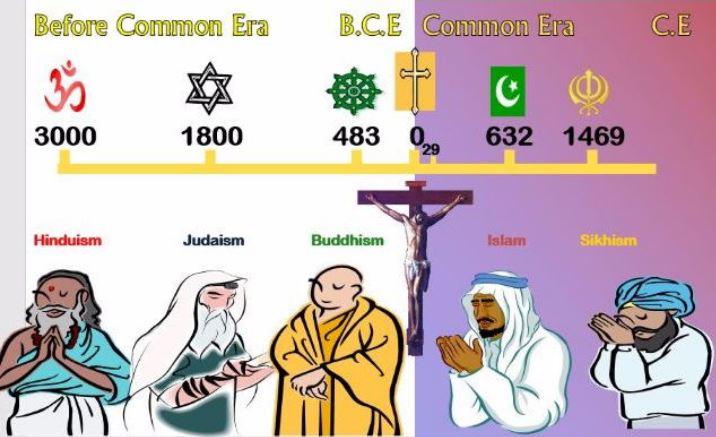
Regarded from this point of view, mysticism is the basis of all religions–particularly of religion as it appears in the lives of truly spiritual people
“Mysticism is a theory, doctrine, or view that considers reason to be incapable of discovering or of realising the nature of ultimate truth, whatever be the nature of this ultimate truth, but at the same time believes in the certitude of some other means of arriving at it.
If this definition be accepted, then this ritualistic philosophy of the Hindu Vedas is the earliest
form of mysticism that is known to India or to the world.”
S N Dasgupta – Hindu Mysticism
The mystic quest for immortality is identical with the quest of the highest self, the highest truth and reality, the highest Brahman. It is the realization of the inner spring within life and the inmost spirituality of man as he is within himself, beyond the range of sense and thought.
The chief features of Upanishad mysticism are the earnest and sincere quest for this spiritual illumination, the rapturous delight and force that characterize the utterances of the sages when they speak of the realization of this ineffable experience, the ultimate and the absolute truth and reality, and the immortality of all mortal things.
Yet this quest is not the quest of the God of the theists: this highest reality is no ‘individual being’ separate from us, or one whom we try to please, or whose laws and commands we obey, or to whom will we submit with reverence and devotion.
It is, rather, a totality of integrated, simple experience which is the root of all our ordinary knowledge/experience and which is at the same time the ultimate essence of our self and the highest principle of the universe, the Brahman or the Atman (The Soul’s Personal Higher Power).
“I know this great existance who resides beyond all darkness (of sin and ignorance), as bright as the sun. He who knows Him escapes death and there is no other way of escape.
There is nothing superior to Him, and there is nothing which is greater than Him, and there is nothing smaller than Him. He stands alone by Himself in the Heavens unmoved like a tree, and yet the world is filled by this existance.”
Shvetashvatara Upanishad
As we integrate the awareness of the implications of E=MC2 this ancient mystical understanding becomes entirely relevant to our spiritual journey today.
Relevance of the mystic awareness to excessive modern consumption was also addressed in the consideration of the Hindu scriptures. (And if the myth that Jesus traveled to the East prior to his ministry is true, then consider how closely Jesus’ story of the Rich Merchant compares to that below)
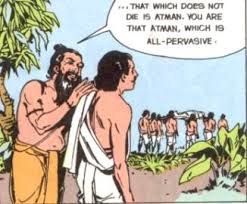
A story is told in the Katha Upanishad according to which King Vajashravasa made a sacrifice involving a gift of all the valuables that he possessed. His son Naciketas, asked if he was to be given away also.
In anger the King said to his son “I give you over to death.” Then Naciketas went to the place of Yama, the king of death, where he remained fasting for three days and nights. Yama, willing to appease him, requested him make a wish.
Naciketas replied that men do not know what happens to people when they have passed from earthly life to the spirit realm, whether they still continue to exist or whether they cease to exist; and he requested Yama to answer this question first.
Yama’s response is that it was easier for him to give long life, gold and earthly enjoyment. But the philosophical quest was dearer to Naciketas than all the earthly goods that the king of death could bestow upon him. Money, he thought, can not satisfy man; money is of use only so long as a man lives, and he can live only so long as death does not take him away. Naciketas preferred to solve this mystery and riddle of life rather than to obtain all the riches of the world and all the comforts that they could purchase.
“Desire for money blinds our eyes, and we fail to see that there is anything higher than the desire for riches, or that there is anything intrinsically superior to our ordinary mundane life of sense-pleasures and sense-enjoyments. The nature of the higher sphere of life and of the higher spiritual experiences cannot be grasped by minds which are always revolving in the whirlpool of mad desires for riches and sense-enjoyments. ”
So Yama, the king of death, says to Naciketas that the majority of the people do not believe that there is anything higher than the ordinary mundane life. Most think that being content/happy with the common concerns and interests of life are sufficient. It is only the few who feel a higher call and are happy to respond to it and to pursue a course of life that seeks to find a bliss not available in things or within time.
See also: What would be Your Bliss?





 congregation. However the death of both her mother and her daughter led her to look for a different level of connection to what she gained from her weekend religious activities. Through LISN membership Annabel found inspiration from others who have had similar losses, and who were nearby.
 Ethelia is lonely, new to her new village, and with specific spiritual interests which could be called ‘mystic’. Her country does not permit views contrary to the national religion. Ethelia longs for people to explore questions and inspiration with, and finds LISN.
 anyone else knowing what they are. He likes that.
 He joined LISN and then discovered he can also upload his entire cohort of parishioners as users, so that they are part of the membership of LISN, but specifically assigned to his care group.
 He had recently found a number of small groups existed that he did not know about. His attempts to get people to let him know had not worked, probably because things were constantly changing and there was no online method for people to update their own connections.
 She looked online and found lots of offerings but no indication if they would match what she was looking for. By registering and defining membership with LISN she was able to define her own spiritual expectations in a fun way, and in doing so the list of local Spiritual Directors was somehow narrowed down to those who matched her needs and style. She loved not having to research a whole lot of options and found it easy to choose one that works well with her spirit.
 becomes:


 LISN also has mapping and organizational support for small groups, circles, councils. LISN can link a person to spiritual circles or groups who are local or in a vicinity of interest.


 The content of LISN is kept in pages of information, which are categorized according to content. You can find such pages filtered by category, by selecting the LISN category from the side bar drop-down list. You can find Interactive Question Surveys (IQS) is a category.
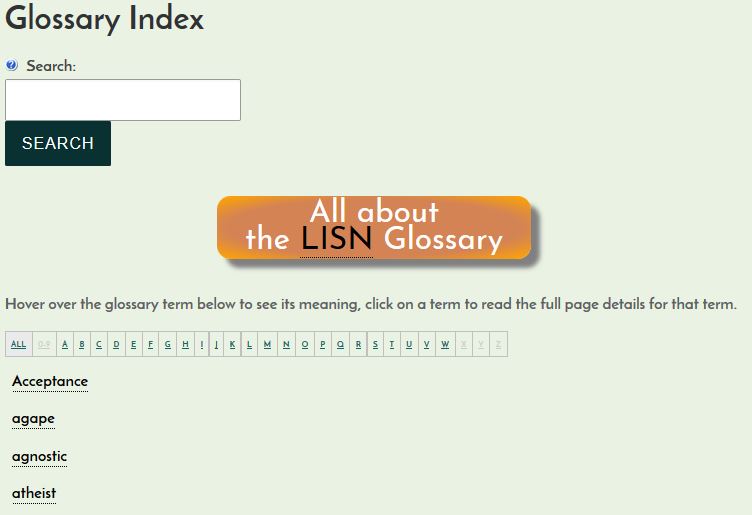
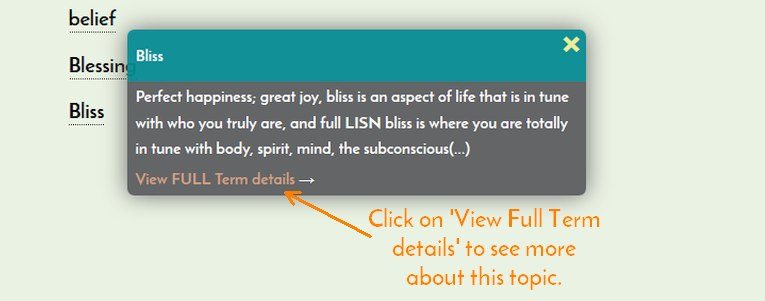
 Click here to go to the glossary and learn more.
 Click this arrow button to submit your feedback!
 or enter your search address for where you are.